Monday, 16 September 2013

Interview: Mischief with Allo Darlin' inspires new Wave Pictures record


A tour with indie pop stars Allo Darlin' has inspired The Wave Pictures' new album City Forgiveness. ShadowPlay caught up with frontman David Tattersall to discuss the album and the band's future.

If a decade of being told his voice is a dead ringer for Modern Lovers singer Jonathan Richman is wearing, then Wave Pictures frontman David Tattersall doesn't show it. The likeable songwriter cites Richman's 2008 album 'Because Her Beauty Is Raw and Wild' as a key influence to new album City Forgiveness, along with Rory Gallagher, Neil Young and rumba singer Franco and the OK Jazz.
 David Tattersall

But there's one key influence on the latest LP from the prolific trio - Allo Darlin'. The Fortuna Pop outfit accompanied the Wave Pictures on a six week tour of the US last year and double album City Forgiveness is the result of the trip. "The best thing about that tour was that we all became friends. The highs would be hanging out and drinking tequila and playing frisbee. The lows would be driving nine hours a day in the hot sun," Tattersall explains.

Release on hip London label Moshi Moshi on October 21, the record will be eagerly anticipated by the band's unique and oft-obsessive fan base. "We think it's the best thing we've ever done! We're very happy with it," explains Tattersall. "We have great special guests on there: Paul Rains from Allo Darlin, Stanley Brinks and others. And we've got a deep, rich sound that we never had before. The album has more tones and colours than on our previous efforts, more life, more energy."

If single The Woods is a marker than that description is more than accurate. A live version of the track recorded seminal east London studio Toe Rag shows Tattersall's trademark off beat lyrics ("I have unattractive nurses in my dreams/ stacked  low like pancakes") married to an infectious relentless dirty rhythm to give a performance as good as any the band have ever put in. 

"It was really really fun," Tattersall says of the Toe Rag session. "We certainly enjoyed the analogue aspect of the studio, the absence of a computer was delightful. I don't like computers much to be honest and I try to avoid them for the most part."

New album City Forgiveness
Formed in the East Midlands in the late 1990s, The Wave Pictures - Tattersall, bassist Franic Rozycki and Jonny Helm - have progressed to become royalty in the anti-folk scened finding fans and collaborators in comic supremo Jeffrey Lewis, Mountain Goats frontman John Darnielle and Swedish folk legends Herman Dune among others. 

"We've been lucky right from the start with all the wonderful people that we have worked with. I remember hearing Jeff Lewis on John Peel when I was a teenager living in the East Midlands at my parents house," says Tattersall. "I thought his songs were incredible then and I still do now, and we've been friends for ten years and Franic played mandolin on his last album.

"I was uplifted by playing with Daniel Johnston: his songs really cheered me up and made me happy."
The Wave Pictures are one of the hardest working bands in the UK and their staggeringly prolific output has seen the trio release approaching 20 albums as well as solo projects and spin offs. Their tales of marmalade statues and avocado babies have combined with electric tunes like Jimmy Reed and Just Like a Drummer to retain a buzz around the band. Regular tours around the UK, US and Paris include headline slots in New York, a forthcoming gig at the Jazz Cafe in Camden on November 13 and the band even played ShadowPlay's first gig on a snowy night in Sheffield in 2006.

But does the relentless recording and touring ever get too much? "It certainly can be a struggle at times. But we've stayed true to the way we think things should be done. And so we're happy and enjoy what we're doing," Tattersall says.

"Nevertheless, we travel a lot and work hard and it can be a struggle to deal with all the opinions and criticisms that you get and all the indifference too, and all the while you know that the last thing the world needs is another band. 

He adds: "But the secret, I suppose, is to focus on the job at hand and try to disregard everything else that goes along with it. We get along with each other, and we love music, and that helps a lot."

Conviviality then, may be the key, but a heap of energy and a fistful of inventive tunes will doubtless keep the Wave Pictures on top too.

Sunday, 8 September 2013

Could tapes follow vinyl and make a comeback after Cassette Store Day?


If the crunch of a TDK FE90 gets your hair standing on end then the first International Cassette Store Day was a treat. The celebration of the magnetic reel in plastic casing followed swiftly on the heels of the large-scale Record Store Day celebrations in April across the globe. 

Tape day is an event on a much smaller scale, not least as most consigned their tape decks to the attic in the early 2000s, but contains much of the same spirit. The desire to support independent music and look a little different and cool at the same time has driven the creation of both days while guilt over the torrent of free music enjoyed by fans is possibly also a factor.

There are a handful of great events worldwide. A plethora of great shops across the country - from Pie & Vinyl in Southsea to The Music Exchange in Nottingham sold exclusive tapes from the likes of Los Campesinos! and Bonnie Prince Billy. Labels including 4AD, Transgressive and Wichita re-released classics from the likes of At the Drive-In and Deerhunter on tape which were sold across Europe, North America and the UK. In Brooklyn, US there's a tape fair while Tokyo hosted live music.

In London, Rough Trade East and West sold the tapes and the former hosted a couple of live bands. A cluster of tape fanatics quickly surrounded the limited wares on the shop's counter as soon as they went on sale and pawed over their carefully put together casing and beautiful artwork. 

Personally, I love the format. As described in Tom Bonnett's beautifully put together interview with me earlier in the week, tapes offer an honest and enticing way to release music. Homemade tapes - which, it appears, did not kill music - can be used to convey everything from romance to pure serendipitous sharing of music while artists' releases can soundtrack a car journey perfectly on tape. At the day, I picked up a couple of crackers - an exclusive mixtape by Jeremiah Jae and Teebs and a special Lex release of JJ Doom's Key to the Kuffs which sees MF Doom team up with the likes of Thom Yorke and Beck. Glorious.

The resurgence of vinyl over the last decade has been driven by a number of factors including more people DJing at home, a desire for a product worth paying for in a digital music world and the popularity of 7"s for indie bands. For tapes too, the use of them as something different to offer fans by cultish bands has become increasingly commonplace and has sparked a mini revival. 

However, with many tape decks on the scrap heap, their traditional home of the car glove box now dominated by a Sat-Nav and the fact even staunch musos can't say the quality is better on tape will make this a much harder battle. For now, let's be happy that the nerdy part of our desire for music to feel authentic is appeased by this celebration of a much love format. 

Tuesday, 3 September 2013

Egon Schiele's work - ShadowPlay's top picks


Austrian painter Egon Schiele's work has consistently drawn me to the icy stares and twisted body shapes of his portraits. Mentored by Gustav Klimt, Shiele spent much of his working life in Vienna and one of my favourite town's Cesky Krumlov, Cz. Here, we pick some of his most stunning work and tell you where to see it.


Portrait of the publisher Eduard Kosmack (1910)
This portrait of the Vienesse publisher has always struck me as full of tension and menace. I often wonder whether Kosmack would have been dismayed at Shiele's portrayal of him but the details on his hands ears are vivid.


The Green Stocking (1914)
The contrast between the green and orange clothing is striking, as are the woman's typical Shiele features - angular and aggressive. A captivating piece.


Holy Family (1913)
Religion doesn't feature heavily in Shiele's work but I've always found this piece striking. In his book on Shiele, art historian Wolfgang Georg Fischer says: "The child has the quality of an apparition. About the woman's head there is a yellow halo and the hands seem to be making ritual gestures."

Artist's Wife Painting
The way her feet disappear into nothing give this a fantastic ethereal quality.


The unusual pose in this one and the elongated fingers are eye catching. And she's pretty foxy.


Top places to see Egon Shiele's work
The Egon Schiele Art Centre, Siroka 71, Cesky Krumlov, Czech Republic
Leopold Museum, Museumsplatz 1, Vienna 1070, Austria
Neue Galerie, 1048 5th Ave  New York
Österreichische Galerie Belvedere, Prinz-Eugen-Straße 27, 1030 Wien, Austria

Monday, 26 August 2013

Notting Hill Carnival 2013 in photos


The annual explosion of colour that is Notting Hill Carnival was no less spectacular this year as collections of London's diverse communities poured onto the streets in their usual haphazard fashion. As a local resident of a few years, I'm always proud to have such an event on my doorstep. 

It pains me to hear snooty neighbours and those who've never been complain about the noise and rubbish when the nub of two day festival is celebration. Here's a few snaps, some from Sunday's sound systems, notably the fantastic Channel One, and some extraordinary scenes from today's floats. If you missed it this year, there's always next year… 


For some slightly more professional and quality shots, there's a great London 24 gallery here.

Sunday, 11 August 2013

Review: The Summer Exhibition, The Royal Academy


A visit to the Summer Exhibition at the Royal Academy, Piccadilly Circus is always a conflicting experience. On the one hand there's the overly earnest art aficionados thumbing through the price guide as if it were their cheque book and making banal observations, on the other there is the sheer joy of seeing the everyman artistry on display.

While I'm sure there's plenty of back slapping, favouritism and nepotism in the selection of the pieces which go on display at the annual exhibition, there's plenty of raw talent too. Wandering the halls of one of London's most grandiose galleries you get to see Tate Moss' painting of a desolate abandoned building alongside another depicting a building as a crazy golf course and a snakes and ladders board with film directors on. 

Elsewhere among the 1,200 works there's Ron Arad's sculpture of a Fiat 500 and a fantastic photo of a bloke sat on a bench in St James's Park alongside one of its famous pelicans. Easily the most astonishing work was Grayson Perry's modern tapestries - a room featuring six large tapestries depicting the downfall iPhone wielding technology magnate Rakefield which is startling in how vivid it is in traditionally a dour medium. 

The 245th Summer Exhibition offers an eclecticism rarely seen anywhere in the country bringing together vastly disparate mediums. An old girlfriend of mine often toyed with the idea of entering and I hope she eventually did because there's such a breadth of work here that no one can fail to be inspired.

Review: The Turner Contemporary, Margate


The Turner Contemporary overlooks the sea

The following day yielded a trip to Margate with the seaside town well within reach of a day trip from London on the Kent coast. In my day job at Retail Week, we've covered high street campaigner Mary Portas' attempts to breathe life into a once bustling town extensively. Having interviewed Portas several times I can attest that her passion appears genuine and can entirely understand why her efforts in Margate, which descended into conflict with local residents, were so frustrating. 

There is clearly the basis for a thriving economy in Margate. The swish cafes and second hand shops of Cliftonville and behind the harbour square point to the kind of middle class haven that Whitstable offers for visitors up the coast while its sandy beach should be thronging on an August day. 

But the facade of empty arcades and abandoned lidos along the seafront belie a town which has not been able to take advantage of the cringingly titled Staycation movement of the last few years while other British seaside towns have boomed. 

The gallery was opened in 2011
The Turner Contemporary, situated by the harbour, was seen as a key in Margate's regeneration when it opened in April 2011 and it's easy to see why. Filled with the cafe, gift shop and sleek concrete architecture and every successful modern gallery, the gallery has received over a million visitors since opening. 

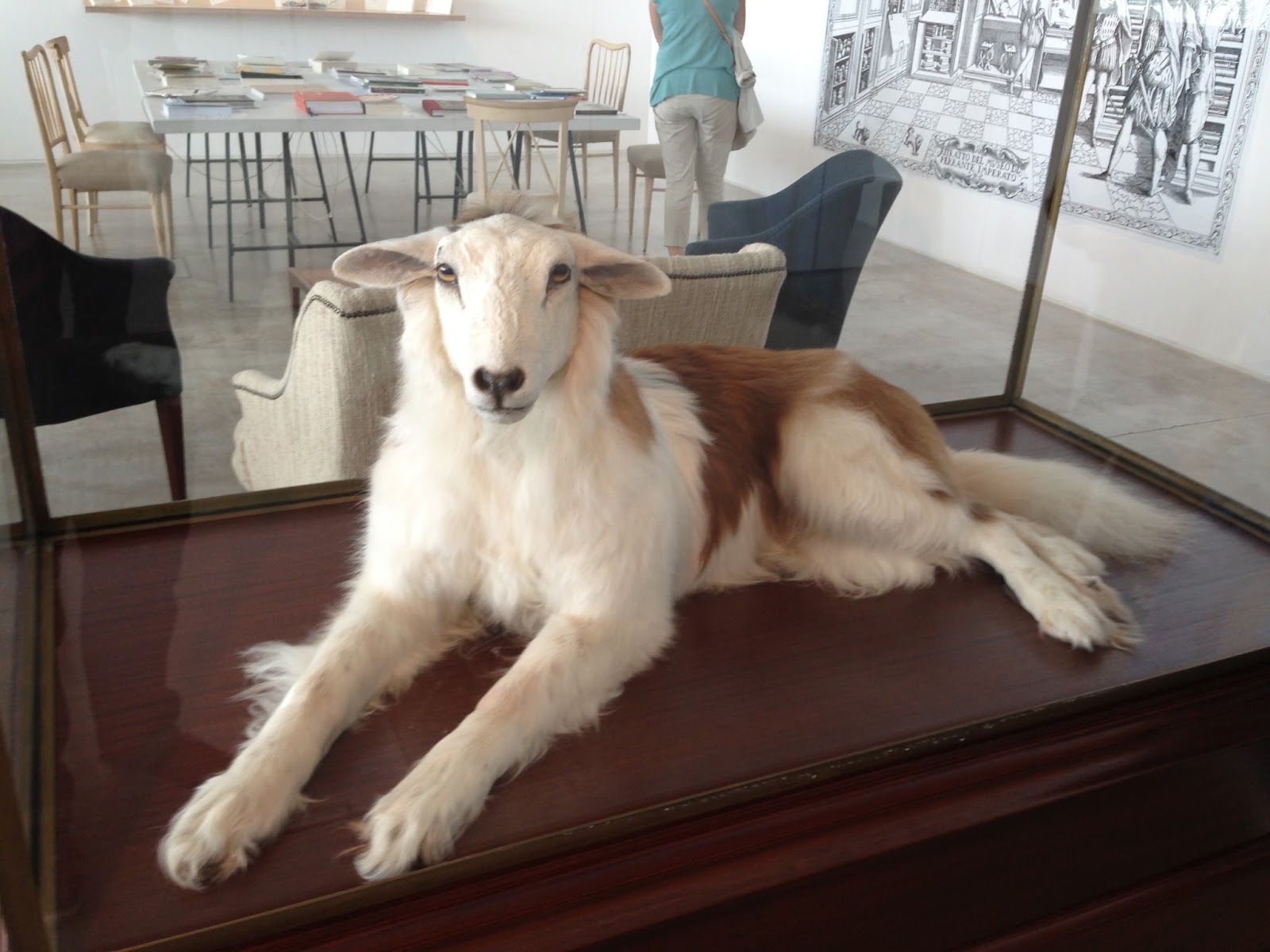
The current exhibition on Curiosity proves excellent, if a little freaky a times. Visitors are greeted by a literal sheepdog while the penguin and peacock melded together by Thomas Grünfield could also yield nightmares, evoking memories of the League of Gentleman beast. 
Thomas Grünfield's Penguin Peacock

There's also some original Latin Leonardo Da Vinci scripts and a room entirely dedicated to Swiss art including some ghoulish traditional masks which were apparently treated with disdain by the Swiss government as well as cards asking visitors what their curiosity is. After neatly asking how exactly a swan does break a man's arm, I head for the exit impressed by the gallery. Less impressive is patron and local Tracey Emin's scrawled artwork on vinyl on a shop opposite. 


Naturally it's a little condescending to diagnose a town's ills as a Londoner however there is a feeling that Margate could easily return to its former glory if a cultural and generational shift is willing to embrace it. And who's to say sleek, modern art cannot be at the centre of that?

An unusual greeting


Monday, 8 July 2013

Snapshot: Yorkshire acid house DJ Blawan


Who are ya? 

Yorkshire acid house specialist Blawan, aka Jamie Roberts, has caused a stir since arriving in style three years ago with a clutch of percussive, cold acid house tracks. Ultra-cool techno label Hessle picked up his 'Fram/Iddy' tune last year and his career has snowballed since. Inspired by Ben UFO DJing on Rinse FM, Roberts escaped the post university malaise to DJ around the world. Born in Thurnscoe he began his musical life drumming in post-punk bands. Now firmly based in the capital, he sports a true East London look complete with oversized caps and natty facial hair. 

What does he sound like?

Roberts cites The XX and Moderat producer Untold and Hessle label mate Pangae among his influences and their penchants for slower, building groovers is clearly evident in Blawan's style. After escaping early flirtings with more synthetic sounds, Roberts has used his drumming abilities to fine effect and has gained a ferocious live reputation for stinking sets packed with intense bass and carefully nuanced drops. 

What's he done? 

Since the release of Fram in 2010, he has strung together a collection of hits on a plethora of trendy labels including Belgian techno label R&S, Hessle and Hinge Finger. His Bohla EP was snapped up by London's DJs while Getting Me Down, which features an exhilarating R&B diva sample, was named Resident Advisor's best single of 2011. He has scooped a number of prestigious sets including Manchester's Warehouse Project and collaborated with fellow hardware specialists The Analogue Cops and Pariah. 

What are people saying? 

"Perhaps the highlight so far of the UK underground’s recent fascination with acid house, you wouldn’t need to be told that to figure it out from his tunes. Built from rambunctious, elastic rhythm tracks that whip, snap, and crash in all directions, they always land in a wonderfully satisfying thud even if not always in the exact place you’d expect pretty much sums it up." - Fact Magazine

What does he look like on the wheels of steel?


Sunday, 16 June 2013

Why Iain Banks was the perfect author to pen his own death


'It was the day my grandmother exploded. I sat in the crematorium, listening to my Uncle Hamish quietly snoring in harmony to Bach's Mass in B Minor, and I reflected that it always seemed to be death that drew me back to Gallanach.'
Prentice McHoan's openings words of The Crow Road often come back to me in moments of dark humour and it is fitting that their author's passing this week came after a period resigned to his death. 
Banks died this week just three months after announcing he had been diagnosed with gall bladder cancer and just 11 days short of the publication of his final novel, The Quarry. Morbid irony has been something on which Banks has built a career so although his final novel casts a narrator dealing with his dad's terminal cancer, he was 87,000 words into the book before discovering his own illness. "I've really got to stop doing my research too late. This is such a bad idea," Banks said before his death.
The tributes which have poured in via the prolific writers' fan site have been astonishing and it's heartening as a true fan myself to see that other people have had similar reactions. From identifying with his characters to taking inspiration from his musical references, Banks has helped shaped my life and plenty of others' too. 
Like another personal favourite, Haruki Murakami, Banks was not afraid to riff on the same themes novel after novel, giving the readers what they wanted and keeping his focus narrow in his works. Where Murakami writes about jazz, hotels and cats, Banks visits misjudged youth, death and remote Scottish locations. He also identified that this distinct brand differed significantly from his science fiction writing to the point it may alienate (pun intended) many fans, choosing to pen the sci-fi novels under Iain M Banks in a clever move. 
Joseph McFadden as The Crow Road's Prentice McHoan
Perhaps his finest achievement was to create believable characters. From the flaws that lie in bass guitar rock'n'roll star Dan 'Weird' Weir in Espedair Street to journalist Cameron Colley in Complicity, the odd foibles and failings of his distinct main characters, McHoan in particular, are something to revel in. Banks is also able to weave in the darkly humorous and odd too. In arguably his most celebrated novel, The Wasp Factory (Banks' debut aged 30), Banks creates Frank Cauldhame, a 16-year-old with a fascination for killing insects and a bizarre relationship with his family that results in a wicked twist at its conclusion. Banks' ability to sooth and shock in equal measure through twisted and depraved imagery cannot be underestimated. 
He described himself as a 'slacker' but wrote a swathe of mainstream bestsellers which he knocked off a couple of months at a time at a rate of 3,000 words a day.    
However, Banks was not a flawless character. His sci-fi novels were often hugely indulgent while Raw Spirit, a travelogue of Scotland and its whisky distilleries published in 2003, is an example of success allowing artistic freedom to publish vanity projects. Moreover, his brusk manner, often interpreted as arrogance, made Banks a hard person to like in interviews. 
But the calm, quiet manner in which he slipped from this world showed in his actions that Banks was the wry characters his books suggest.
His writing will be missed and his legacy remembered. Let's hope there's no explosions at the funeral. 

Sunday, 9 June 2013

Stoke Newington Literary Festival: Paul Morley on The North


The plush surrounds of Stoke Newington Town Hall appear an unlikely setting in which to discuss a region typified by spit'n'sawdust, steel and graft. But if there's one thing the excellent annual Stoke Newington Literary Festival provides it's variety, from big names including Irvin Welsh, Caitlin Moran and Tariq Ali to comics, poetry and even Sonic Youth's Thurston Moore, the week-long north east London festival has everything and some great venues to host them in. 

Former NME journalist and author Paul Morley, who was born in Surrey but grew up in Stockport, has come to discuss his book, The North. However, as he explains, he usually gets booked as a last minute stand-in to interview authors about their books. As such, with no such interviewer available, he opts to interview himself - selecting content from a Q&A sent by his publishers.

The format itself is a clever idea - he says he once did it before in split screen on BBC2's The Late Review - but struggles in reality. The book itself is a collection of studies on various northern artists and their views of the north but you wouldn't get that from the first half hour in which Morley addresses his concept of 'a north' in which he essentially explains why the book is heavily biased towards the North West, in which he grew up. 
Despite the interview premise, the talk is rambling and structureless, full of great nuggets - the Stockport viaduct features 11 million bricks donchaknow? - but undermined by pulling back to discuss the book's authenticity every time he piques interest. 

Albert Tatlock
He talks about what Albert Tatlock, Ken Barlow's uncle on Coronation Street, the archetypal grumpy northerner, would have made of the book and makes an interesting observation that Shameless' Frank Gallagher may have taken on this TV mantle. But, again, it's about how it may be perceived. One reason, I suspect, is that Morley moved to London following the infamous Sex pistols Free Trade Hall, Manchester gig in 1976 and he wants to ensure that the book has a ring of truth.

However, his frequent excellent writings on northern musical heroes including Ian Curtis, and The Human League give him this authority and he shouldn't be afraid to stick to it. Moreover, I ask him after the talk, why music didn't play more of a role in his readings, given his first hand accounts of people who have defined the north would be fascinating and invaluable. He replies that figures like The Fall's Mark E Smith do feature but in truth there's not the colour or the effervescent anecdotes which would lighten the whole event. 

Morley does make a good point however, when he address the fact that there being a 'North' means that it's defined by a South. He talks about how trains have to stop at Stockport on the way to London and that northerners perhaps over-egg their love of where they're from in the face of stereotypes etched out by southerners who have absolutely no idea where Ravenscar is. 


In essence, this talk is a list of Paul Morley's favourite northerners' from artist L.S Lowry to author Anthony Burgess, waving his glasses and constantly putting them on and whipping them off as he explains his passions. It's certainly interesting however more of his unique musical insight, which many will have attended to hear about, and a stronger view of what being from the north is about would have been more than welcome. 

Sunday, 2 June 2013

Canalival 2013: London at its best and worst


Semi-spontaneous fun is what London does best. We like to know the nearest tube stop, the last bus home and how far it is some Red Stripe and that's about it. 

Canalival 2013
As such, yesterday's Canalival was perfectly imperfect. Planned for months with a clear starting point and DJs scheduled for the event, the follow up to last year's Jubilee celebrations, was cancelled on its eve. What had been a few mates celebrating Queen Liz's honours by getting into Regent's Canal on dinghies became an event which had thousands scheduled to attend on Facebook and major coverage on Time Out. Understandably the police declined to grant the crucial licence which would have allowed the insurance company to back the event.

But the frenzy of excitement the event - a great concept - had brought about was too much to deter potential attendees, myself included. 

As such, I poled down to the canal, skirted a lock and was helped in by our 'Canal Angel' - a woman in a denim jacket with loads of lippie and a megaphone who can only have been one of the organisers. Learning how to stop going in circles with shipmate Claire, stopping to chat to other 'canalies' and comparing our cheap Argos 'Debut' dinghies, the event was lively under the grey clouds and intermittent sunshine of East London.

Highlights included scraping under bridges, trying not to get pulled into bushes, cadging a lift on passing narrow boats, a bloke swimming backwards down the canal using a reverse butterfly stroke off his dinghy and a number of convivial booze swapping moments. The combination of bobbing about, some great music and sights like rafts made of water coolers and the floating island with real sand were fantastic. Not to mention to lone bloke stood upright on his dinghy looking out into the middle distance wearing a poncho. 

But there had to be a downside and the troop of trendy East London types shoving other boats out of the way, pissing on people's property, climbing on moored boats and abandoning dinghies and their packaging felt inevitable. Clearly with the crowd funded monies and community support, the organisers would've been able to clear up after the event swiftly and limit damage to the locale. However, that was no longer available despite the organisers admirably taking responsibility and taking part in the clean up. In the end loads of dinghies got wedged near a lock and someone even let of a flair which, as they always do, made things look a bit nasty. 

There has been a lot of understandable but righteous indignation from locals on social media about the impact and the mess today, but there were also plenty of locals and kids waving to us from the side and enjoying the action too. 


Inspired: A floating island
Clearly the belligerence of hipsters out for themselves and to look good on Instagram knows no bounds, not least if you look at Field Day and its impact on the area around Victoria Park. However, for the rest of us the opportunity to enjoy a nice stretch of the canal and share it with those who live on it year round doesn't seem too much to ask. Too often large groups of young people are vilified for having fun in a city awash with rules. As a Notting Hill resident, one of the best features of living here is the Carnival each August and embracing unexpected fun in the locale is something those living in London, with of its weird quirks and flash mobs need to deal with. 

Social media spurred the clean up today and I don't see any huge reason why the event shouldn't happen again, albeit a difficult one to cope with the huge numbers and demand (several people offered to buy our boat). Long live Canalival and all those who sail upon her.

In video: Canalival 2013